



Table Of Content
Choosing the right gemstone for an engagement ring or fine jewelry can feel overwhelming, especially when modern alternatives to natural diamonds are now widely available. Two of the most popular options are lab grown diamonds and moissanite. Both offer impressive brilliance and durability, but they differ in composition, appearance, price, and long-term value. For couples planning their engagement ring shopping timeline, understanding these differences early can make the decision process much smoother.
Understanding the difference between these two gemstones can help buyers choose a piece that fits their priorities, whether that’s sparkle, ethics, or budget. If you’ve ever wondered about the price of moissanite vs lab diamond, or asked questions like, “Does moissanite look like a real diamond?”, this guide breaks down everything you need to know.
What Are Lab Grown Diamonds and Moissanite?
-
Lab Grown Diamonds
A lab grown diamond is a real diamond, chemically, physically, and optically identical to a mined diamond. It is produced in a laboratory using one of two advanced processes: High Pressure High Temperature (HPHT) or Chemical Vapor Deposition (CVD). Both replicate the intense conditions found deep within the Earth, resulting in a stone composed of 100% carbon. The process takes a matter of weeks rather than billions of years, and the end result is a genuine diamond with the same hardness, refractive index, and brilliance as its mined counterpart.
-
Moissanite
Moissanite is a naturally occurring mineral first discovered by Nobel Prize-winning chemist Dr. Henri Moissan in 1893 inside a meteor crater in Arizona. The original discovery was so rare that virtually all moissanite used in jewelry today is lab-created. Moissanite is composed of silicon carbide (SiC), a compound of carbon and silicon, making it chemically distinct from a diamond. It ranks as the second hardest gemstone in the world and is celebrated for its extraordinary brilliance and fire.
Moissanite vs Lab Grown diamond: A side-by-side comparison
|
Feature |
Moissanite |
Lab Grown Diamond |
|
Composition |
Silicon Carbide (SiC) |
100% Carbon |
|
Hardness (Mohs) |
9.25 |
10 |
|
Refractive Index |
2.65 (higher fire) |
2.42 |
|
Sparkle Type |
Rainbow/fiery |
White + rainbow |
|
Price vs Natural |
~5-10% of mined |
~40-50% of mined |
|
Ethically Sourced |
Yes |
Yes |
|
Certified |
Yes (3rd party) |
Yes (IGI) |
|
Best Value |
Maximum savings |
Diamond prestige |
Sparkle Comparison: Does Moissanite look like a real diamond?
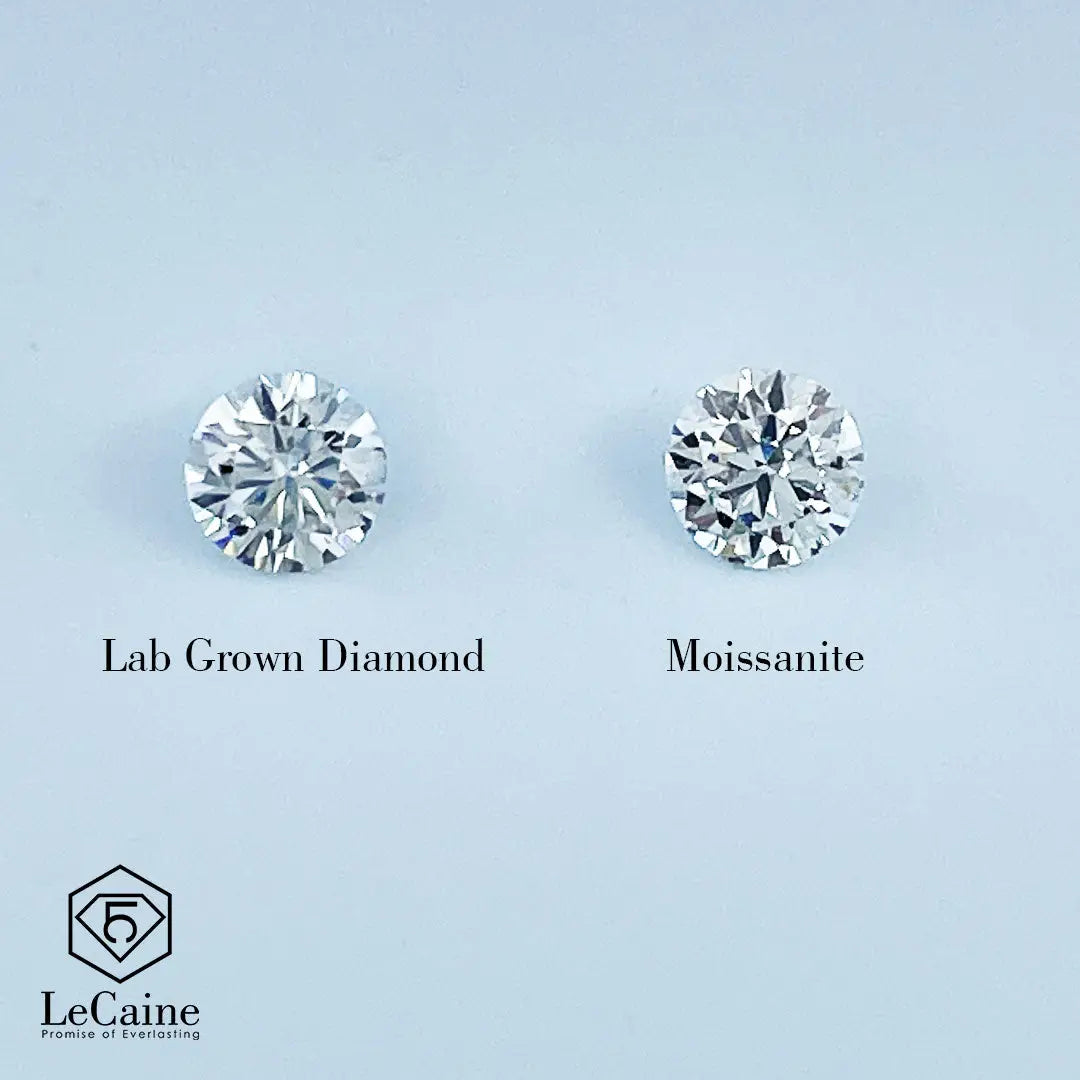
This is one of the most commonly asked questions, and the answer is nuanced. Both stones are visually stunning, but they sparkle differently.
Moissanite has a higher refractive index (2.65) compared to a diamond (2.42). This means light bends more sharply through moissanite, producing an intense, rainbow-like "fire" that is especially vivid under direct lighting or sunlight. Many people find this breathtaking, while others notice it looks more colorful and multi-hued than a diamond. This visual difference is also why many shoppers researching alternatives often ask, “Is moissanite worth buying?”, especially when comparing sparkle and overall appearance.
Lab grown diamonds produce the same classic white-and-rainbow brilliance as a mined diamond. The sparkle is crisp, icy, and traditional, which is what most people picture when they think of a diamond engagement ring.
So, does moissanite look like a real diamond? To the naked eye and in photos, moissanite is virtually indistinguishable from a diamond for most people. Up close and in certain lighting, a trained eye may notice moissanite's extra fire. In everyday wear, the difference is minimal, and for many, moissanite's extra sparkle is a selling point, not a drawback.
Hardness and Durability
Durability is a key consideration for an engagement ring that will be worn every day for decades.
-
Lab grown diamonds score a perfect 10/10 on the Mohs hardness scale, making them the hardest substance on Earth. They are essentially scratch-proof under normal conditions.
- Moissanite scores 9.25/10, placing it just below the diamond and above all other gemstones, including sapphire and ruby (9/10). It is exceptionally durable and highly resistant to scratching and chipping.
Both stones are suitable for everyday wear and will not dull or cloud over time. Neither stone requires special care beyond routine cleaning. Another question buyers often have is, “Does moissanite pass a diamond tester?” Standard diamond testers measure thermal conductivity, and moissanite typically does not register as a diamond.
For most wearers, the durability difference between a 9.25 and a 10 is imperceptible in real-world conditions. Both will last a lifetime and beyond.
Price comparison: Moissanite vs Lab Grown Diamond
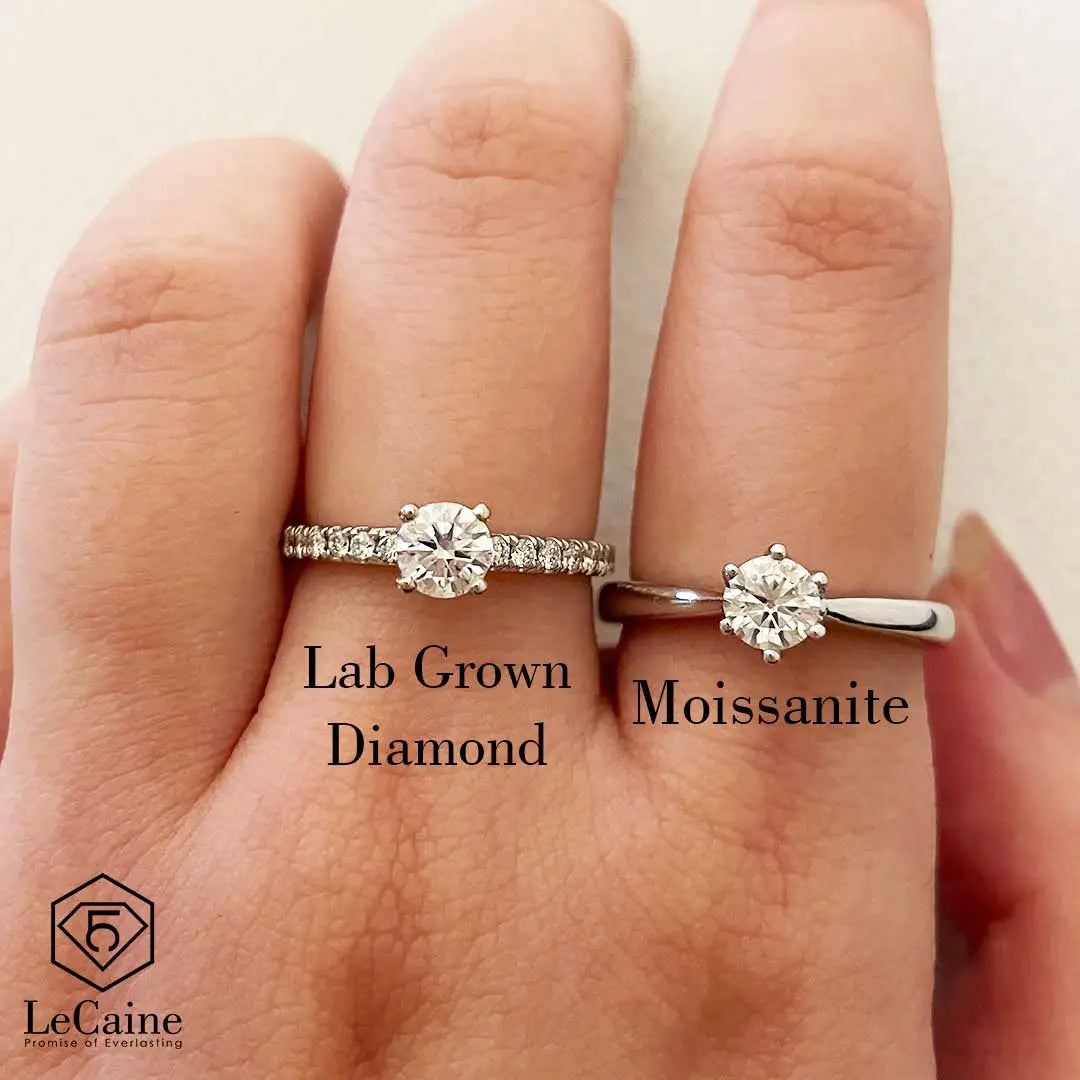
Understanding the price of moissanite vs lab diamond is often the deciding factor for shoppers. Lab grown diamonds are priced at approximately 40–50% of the cost of a mined diamond of equivalent carat weight, color, and clarity. This is a significant saving, but lab diamonds are still priced in the hundreds to thousands of dollars per carat.
Moissanite is considerably more affordable, typically priced at around 5–10% of the cost of a mined diamond. A 2-carat moissanite, for example, can cost a fraction of what a 2-carat lab grown diamond costs, while appearing visually equivalent on the hand.
What this means in practice: Choosing moissanite allows you to opt for a significantly larger stone, a more elaborate setting, or a higher metal grade (such as 18k gold or platinum) for the same budget.
If maximizing visible impact per dollar is your priority, moissanite is the clear winner. If owning a stone with the same chemical composition as a diamond matters to you, a lab grown diamond delivers that with substantial savings over a mined stone.
Ethical and environmental impact
Concerns around moissanite vs diamond ethics have driven many consumers toward lab-created alternatives, and for good reason.
-
Mined diamonds
Traditional diamond mining has well-documented environmental and ethical challenges, including land disruption, high water and energy usage, carbon emissions, and in some regions, associations with conflict financing ("blood diamonds").
-
Lab grown diamonds
Produced entirely in a controlled laboratory environment, lab grown diamonds require no mining. They have a significantly lower environmental footprint than mined diamonds, though the energy used in the HPHT and CVD processes should be noted. When produced using renewable energy sources, the environmental impact is minimal.
-
Moissanite
Moissanite is also created entirely in a lab, with no mining required. The production process is energy-efficient relative to lab grown diamonds, and the technology has been refined over decades. Moissanite is one of the most environmentally friendly gemstone choices available.
Both moissanite and lab grown diamonds are conflict-free by nature.
Which is better for an engagement ring?
Both moissanite and lab grown diamonds make exceptional engagement rings, but the right choice depends on your priorities.
Choose moissanite if:
-
Value is your priority. You get a large, dazzling stone at a price that allows you to invest in a beautiful setting or a higher carat weight.
-
You love that extra rainbow fire and want a stone that turns heads.
-
You want a certified, ethically produced gemstone with excellent long-term durability.
- You want to maximize your budget without compromising on beauty.
Choose a lab grown diamond if:
- You want a stone that is chemically and physically identical to a mined diamond.
-
The symbolic association with "diamond" matters to you or your partner.
-
You prefer a classic, white-brilliance sparkle over moissanite's colorful fire.
- You want an IGI-certified stone with strong secondary market recognition.
At Lecaine Gems, both stones are set in 18k gold or platinum, crafted with the same level of care and artisanship. Our bespoke service also allows you to design a completely custom ring around either stone.
Pros and Cons
Moissanite
|
Pros |
Cons |
|
Extremely affordable, best value per carat |
More colourful fire may not suit all tastes |
|
Outstanding brilliance and fire |
Not chemically identical to a diamond |
|
9.25/10 Mohs, making it highly durable for daily wear |
Some diamond testers may flag as "inconclusive" |
|
100% lab-created, conflict-free and ethical |
Lower resale value than diamonds |
|
Available in a wide range of cuts and sizes |
|
Lab Grown Diamond
|
Pros |
Cons |
|
Identical to mined diamond in every measurable way |
More expensive than moissanite |
|
10/10 Mohs, making it the hardest gemstone on Earth |
Price has been declining, with lower long-term resale value |
|
IGI certified for complete transparency |
The ethical advantage over moissanite is minimal |
|
Classic, traditional diamond brilliance |
Smaller carat size for same budget vs moissanite |
|
Conflict-free and significantly lower impact than mined |
|
Explore Our Collection at LeCaine Gems
Whether you choose moissanite or a lab grown diamond, LeCaine Gems offers a curated collection of fine jewelry crafted to the highest standards. Our stones are set in 18k gold and platinum, and our bespoke service allows you to create a completely custom ring tailored to your vision. Visit us or explore our full collection online.
Not sure where to start? Browse our Cuts & Shank Designs guide, our Ring Settings guide, or contact our team to book a private consultation.